THE TRIANGLE OF MARKO BRECELJ (Rotulus Homo Pendulum) |
Multimedia performance |
Location: Wooden Hall, Monfort, Portorož.
FREE TICKETS:
- Premiere: Saturday, 9 May 2026, at 20:00, Free tickets available at:
or at the box office of Avditorij Portorož – Portorose during opening hours or at Entrio sales points.
- Repeat performance: Sunday, 10 May 2026, at 20:00, Free tickets available at:
or at the box office of Avditorij Portorož – Portorož during opening hours or at Entrio sales points.
Free entry with ticket only.
Co-production: Piran Coastal Galleries, Zavod Delak, Kuća ekstremnog muzićkog kazališta (Zagreb), Društvo prijateljev zmernega napredka.
Authors of the performance: Zlatko Burić Kićo (HR), Damir Bartol Indoš (HR), Tanja Vrvilo (HR), Dragana Milutinović (SRB), Dragan Živadinov (SLO), Aljoša Živadinov Zupančič (SLO).
Project partners: Municipality of Piran, Portorož Auditorium, Ministry of Culture of the Republic of Slovenia, Pohorski Bataljon Foundation, City of Zagreb, Ministry of Culture of the Republic of Croatia, Zaklada Kultura Nova, Jazz Denmark.
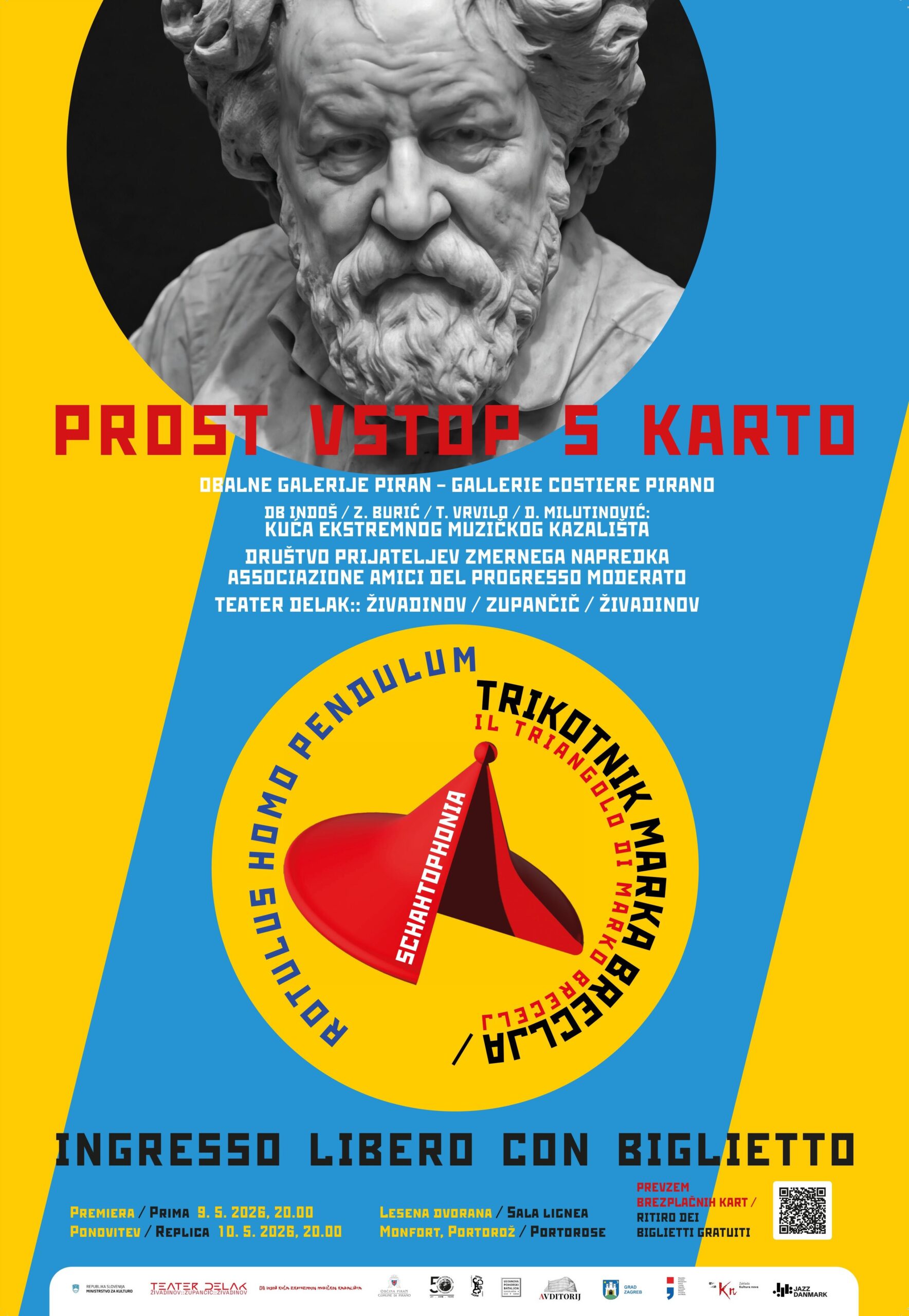
Piran Coastal Galleries, the DPZN Association, Teater DELAK and the House of Extreme Musical Theatre invite you to the intermedia performance THE TRIANGLE OF MARKO BRECELJ (Rotulus Homo Pendulum).
The performance-event is an original work by a group composed of Zlatko Burić Kićo, Damir Bartol Indoš, Tanja Vrvilo and Dragana Milutinović, in dialogue with the cosmo-kinetic dynamics of Dragan Živadinov and Aljoša Živadinov Zupančič.
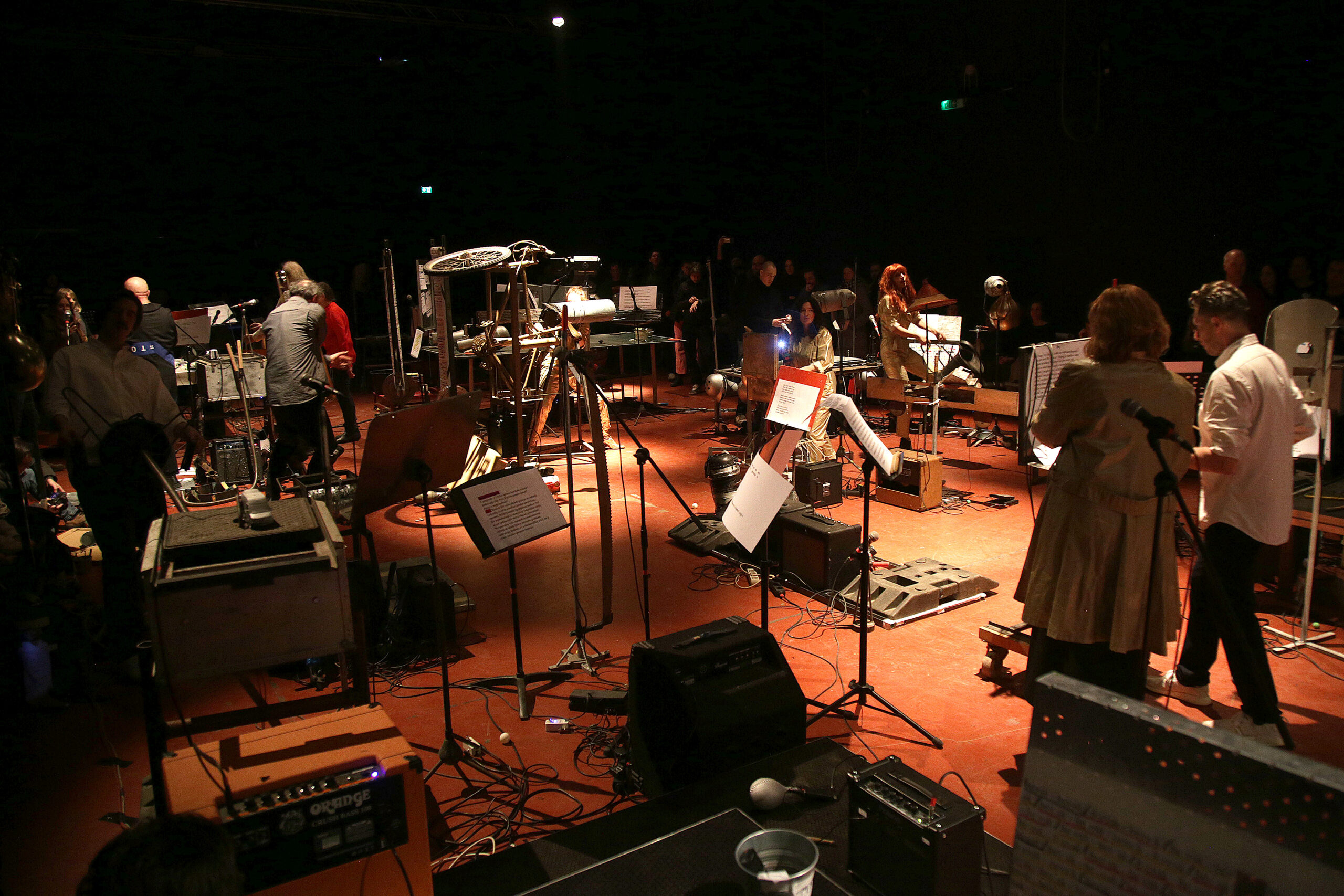
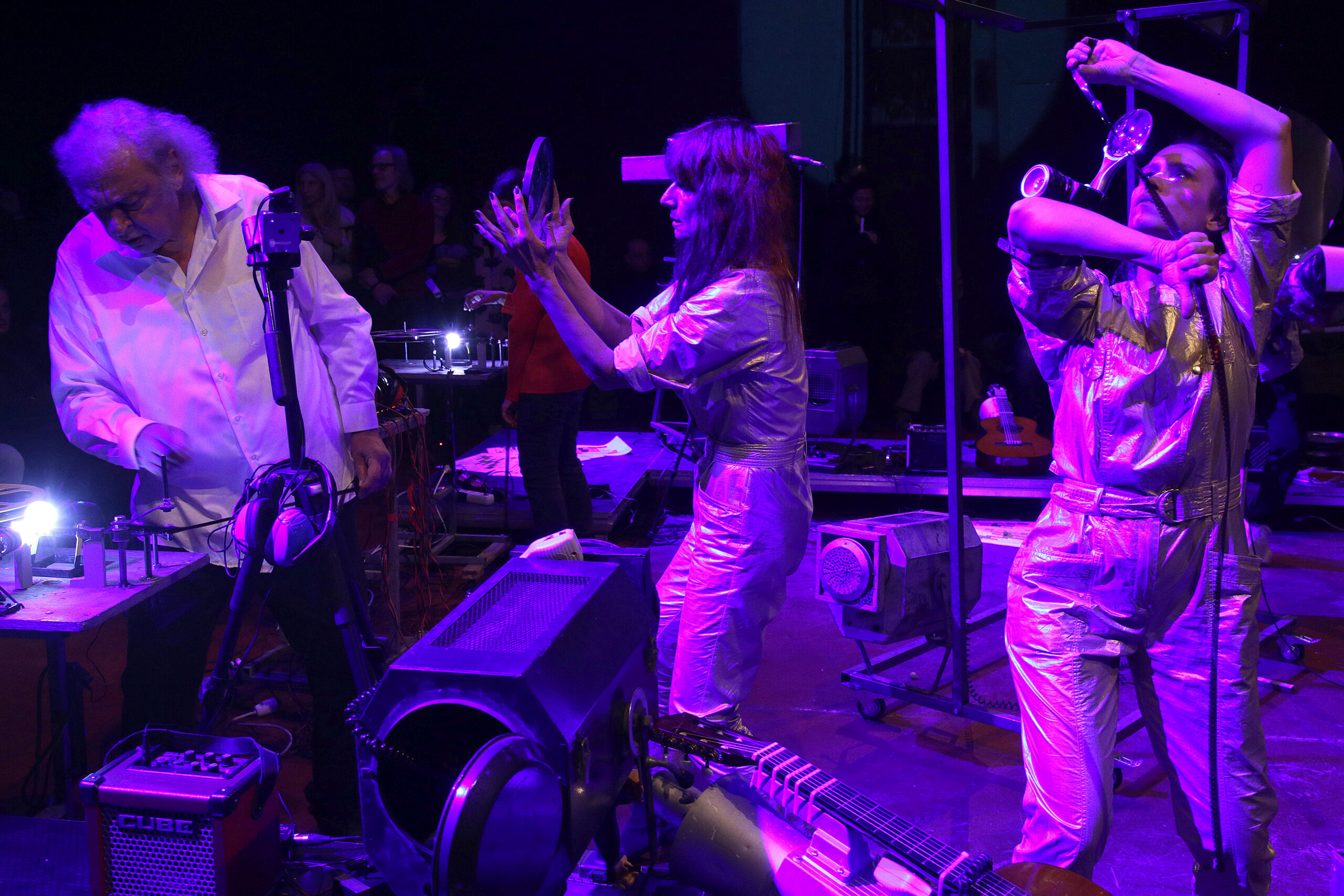
The performance actualizes the effects and modality of emancipatory action arising from the theatrical practices of the neo-avant-garde group Kugla glumište, in collaboration with theatre, visual and music artists of a sensibility similar to that of Marko Brecelj. The extreme music-theatre performance THE TRIANGLE OF MARKO BRECELJ (Rotulus Homo Pendulum) operates within the aesthetics of public and private memory as our common good. It takes as its point of departure the artistic work of Marko Brecelj – poet, performer, musician and activist!
The meta-cosmist landing at the Cape of Good Hope takes the form of a softly performative appearance on the heterotopic scene of youth culture. The multimedia and intergenerational centre, with twenty artists, invites you on a trip to Vršac through the high rotations of comradely offensives. The performance also contains a B-programme for the audience of the future. It includes the celebrated soft-terrorist actions of the Friends of the Present and the audience of the past, with the logic of 30- to 60-second extreme comments. The performance attracts, affects and reconstructs Brecelj’s soft-terrorist actions, songs and video works. It emerges from Brecelj’s many forms of artivism and opens up his diary-like “Dodogovor”, which breaks down the differences between the public and the private, the historical and the current, the absolute and the contingent.
The pre-arranged meeting at the strategic table was inspired by Dragan Živadinov’s performance “BIKOZMIZEM :: Izreka” with the symphonic and melodic Marko Brecelj.
MARKO BRECELJ (1951-2022):
Poet, singer-songwriter, musician, youth and social worker, teacher, and a pioneer of Slovenian performance art. He was the founder of Soft Terrorism as a form of artistic activism, lived as a personal artistic practice without distinction between private and public life.
In 1974, he released the solo album Cocktail with arranger Bojan Adamič, still considered by many to be one of the finest singer-songwriter albums.
Performance is probably the most accurate term to describe his overall body of work—and his life. As a young member of the quartet Beli Črnci, later as the frontman of the band Buldožer, in a duo with Ivan Volarič Feo (Zlatni zubi), and in collaborations with other musicians, in solo performances, performative conferences, films, theatre productions, lectures in independent venues, institutions, and even in politics, Brecelj primarily performed. On stage, in the streets and squares, in various spaces. In Slovenia, across the former Yugoslavia, and abroad.
In 1990, in Koper, in Slovenian Istria, he co-founded the Društvo prijateljev zmernega napredka and, together with collaborators, led and developed an independent venue until his death as a sociological experiment: a youth, cultural, social, multimedia, intergenerational, and museum centre.
As president of the Pohorski bataljon Foundation in the field of non-governmental youth work, he supported and encouraged the establishment of independent venues in Slovenia.
He devoted himself to creative and generous people.
DRAGAN ŽIVADINOV (1960):
Director, performer, and one of the most recognizable figures in contemporary Slovenian theatre. As a co-founder of the Neue Slowenische Kunst movement and the originator of retrogardism, he played a defining role in shaping Slovenian theatre in the 1980s, bringing it into dialogue with the artistic avant-gardes of the twentieth century. His work breaks with classical theatre, placing sign, ritual, idea, and vision at the center instead of narrative, character, and psychology.
Across his body of work, from Krst pod Triglavom to the long-term project Noordung 1995–2045, he has linked theatre with science, technology, outer space, and post-gravitational art. In doing so, he has developed a highly distinctive artistic language in which philosophical reflection, strong visual expression, and the exploration of space, body, and time all converge. An important part of his oeuvre also consists of performative farewell rituals and other projects in which art is understood as a total practice of life and thought.
Dragan Živadinov remains one of the most original and influential figures in contemporary Slovenian performance art, recognized for the consistency of his vision, his theoretical rigor, and his uniquely singular theatrical universe.
ZLATKO BURIĆ KIĆO (1953):
Croatian-Danish actor who has built a distinctive career in European and international cinema over the decades. He began his artistic path in experimental theatre as a member of the influential group Kugla Glumište, before moving to Denmark in the early 1980s, where he also established himself on screen. He is especially closely associated with director Nicolas Winding Refn, with whom he stood out in Bleeder and in the role of Milo in the cult Pusher trilogy, a performance that also earned him the Bodil Award for Best Supporting Actor.
Thanks to his strong screen presence, he soon moved beyond the Danish film scene and appeared in international productions as well, including the role of a ruthless Russian billionaire in Roland Emmerich’s 2012; he also reprised the character of Milo in the British remake of Pusher. Broader international recognition came again in 2022 with his performance in Ruben Östlund’s Triangle of Sadness, for which he received the European Film Award and Sweden’s Guldbagge Award. With this role, he further confirmed his status as one of the most striking character actors of his generation.