A glimpse of the past
During the second half of the 20th century, the international sculpture symposium Forma viva was one of the few examples of figurative art expression in the local environment, renowned for always being updated with the art avantgardes of the time.
Based on the sculpture symposium held in St. Margarethen, Austria, in 1959, the international approach of Forma viva helped the artists expanding their networks, thanks to the connections they had the opportunity to develop while working together.
These factors facilitated the evolution of sculpture towards the trends of contemporary art, combining traditional materials with innovative techniques.
It is not a coincidence that two of the key contributors of the first edition of Forma viva were Janez Lensassi and Jakob Savinšek, Slovenian sculptores.
The name
The idea behind the name “Forma viva” came to the sculptor Jakob Savinšek for the first edition and has since gained recognition and popularity. The title of the event wants to convey the way the artist interacts with its creative activity and the vitality he puts in the research of new forms of expression.
Over time, “Forma viva” became an expression of common use to describe every kind of sculpture placed in an open space.
An event in the name of territorial specificities
Among the sculpture symposia held around the world, Forma Viva emerges thanks to its distribution between four different areas, located at the extreme borders of Slovenia and divided for materials, which were already available in the local territory – Kostanjevica na Krki (wood), Portorož (stone), Ravne na Koroškem (iron), Maribor (concrete) – which defined since the beginning the planning of the event.
Open-air art workshops
The Symposia are genuine open-air art workshops, which gathers together national and international sculptors who capitalize the opportunity to work on large-scale pieces.
The international environment draws the attention of locals, art lovers and passers-by, turning these locations in fascinating melting pots. Even though the Slovene Symposium is largely attended by European sculptors, over the years has also managed to host artists from every other continent (except Australia).
Alongside the prevailing share of Slovene artists, there is also a considerable amount of Japanese attendees.
The Symposium's decay and a new impulse
At the end of the 80’s, after almost thirty years of continuous activity, there was a sharp decline of this international event. Since 1991 the Symposium continued its activity solely in Portorož, continuously. After a ten-year hiatus, the example of Portorož was followed by Kosntanjevica, where in 1998 the wooden sculptures activity restarted.
The Carinthia Museum in Ravne reorganized the group of iron sculptures realized during the years and took the responsibility of the protection and preservation of the artworks.
With these initiatives, some centres showed their interest in bringing the symposia back to life.
The open-air sculptures collection
Forma Viva, thanks to the particular physiognomy of its four different locations and the specificity of the materials, created a unique set of collections of contemporary sculptures placed in the open air. The symposia encompass artworks of artists coming from different parts of the world, each displaying his different background and his own creative input. The considerable heterogeneity of forms and subjects that characterizes the collections offers a valuable source of study for the conception and design of open-air sculptures.
Forma viva today
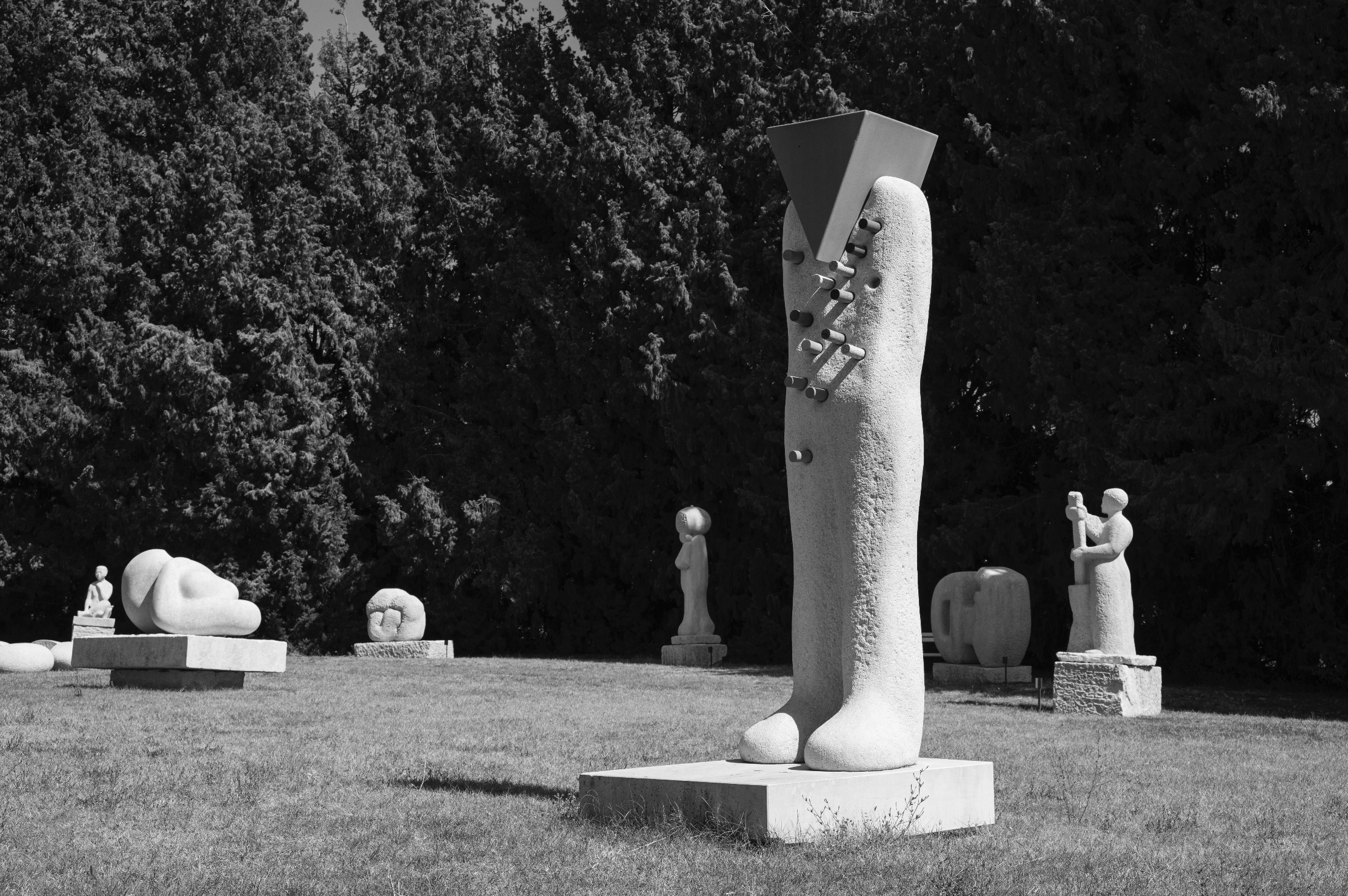
The stone sculpture collection of Portorož amounts today to more than one hundred thirty pieces: most of them are placed on the green peninsula of Seča, while the others are located in the city centres and in the parks of the Slovene Littoral. The connections with the international art scene and the long and continuous tradition of the event are the elements that made the sculpture biennial a staple inclusion into the art lovers’ itinerary, resulting in one of the most ambitious and fascinating examples of dialogue between contemporary art and local environment.
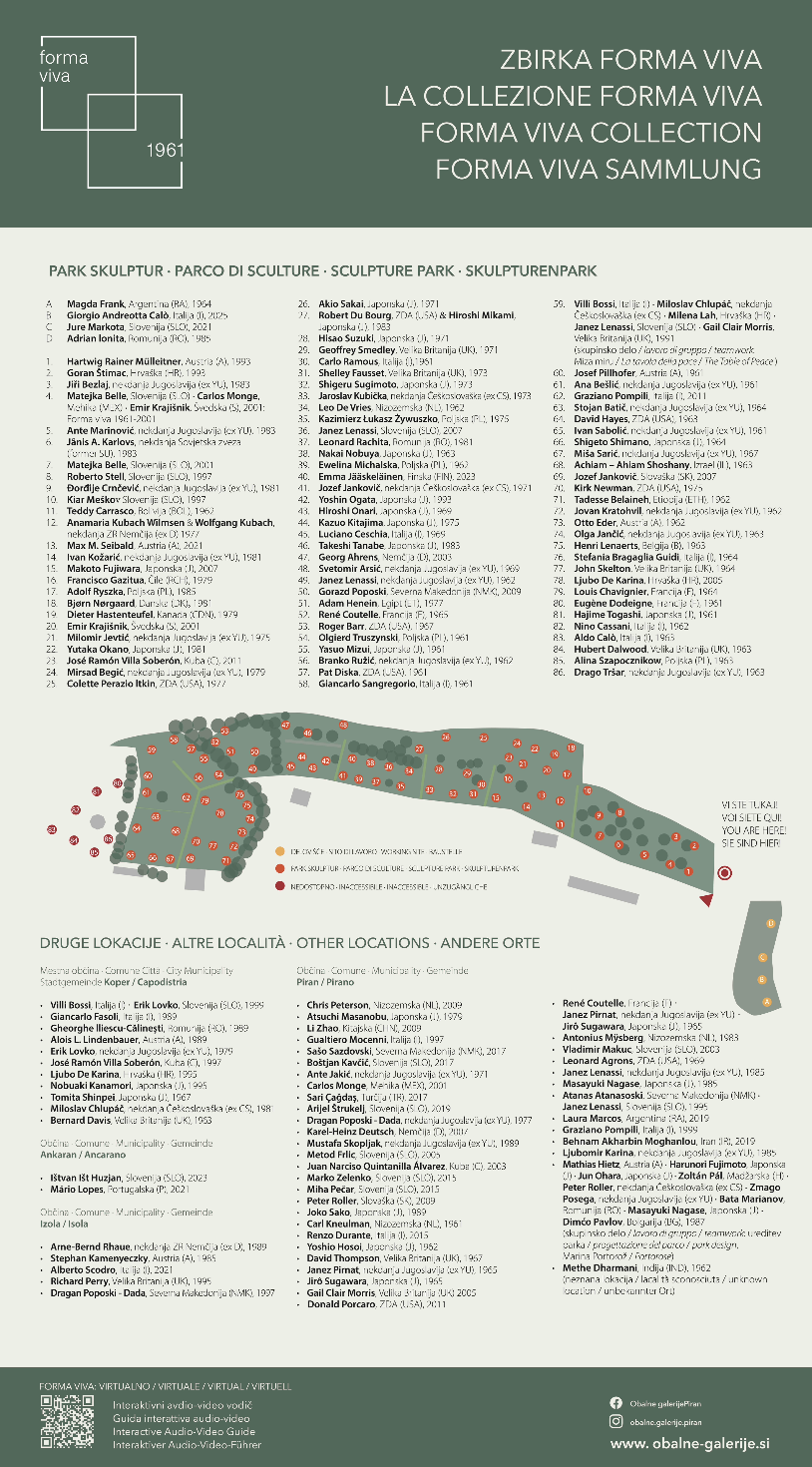
Forma Viva collection: the map
Map of sculptures at Seča, Portorož
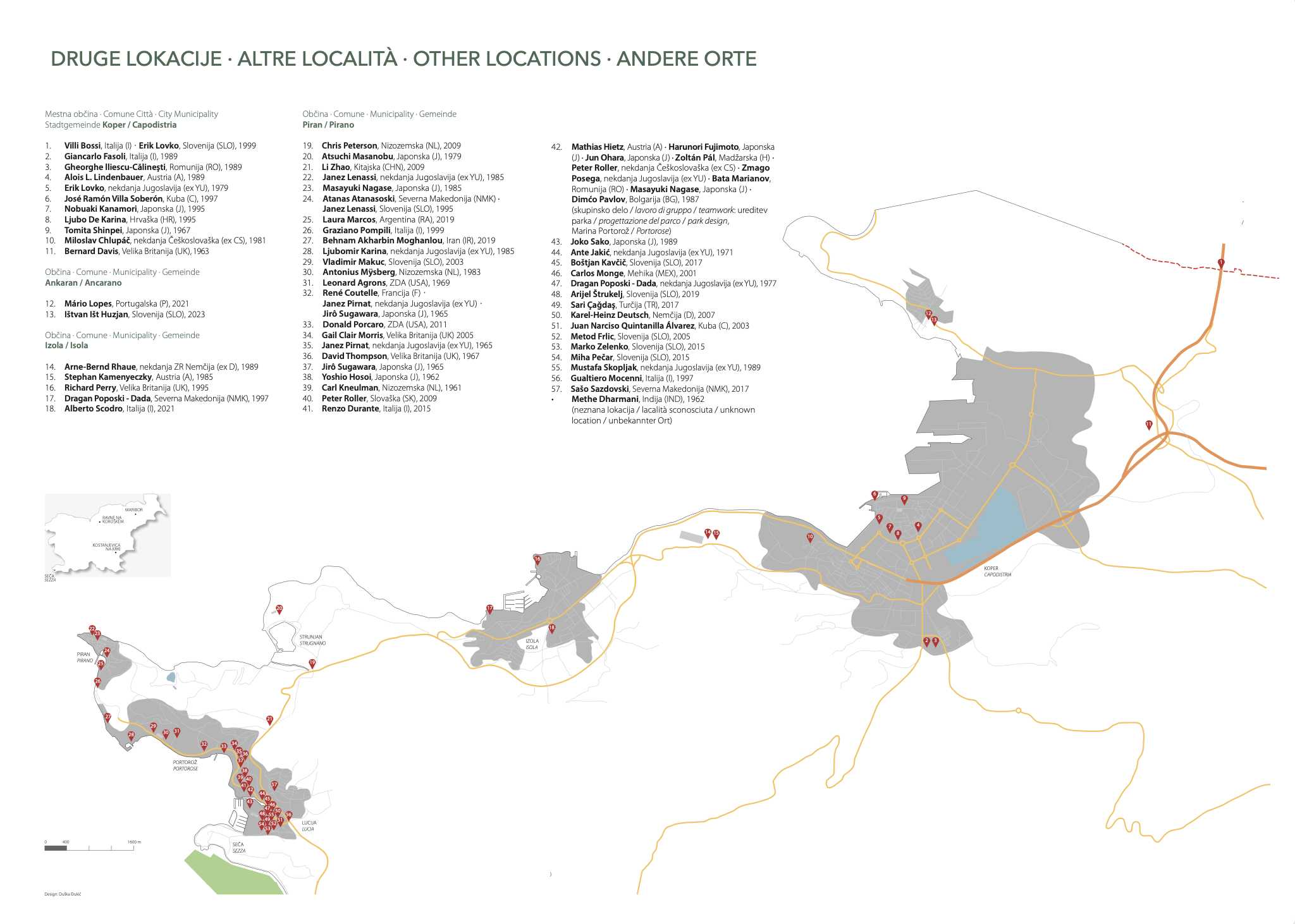
Map of sculptures in other locations (Piran, Izola, Koper, Ankaran)
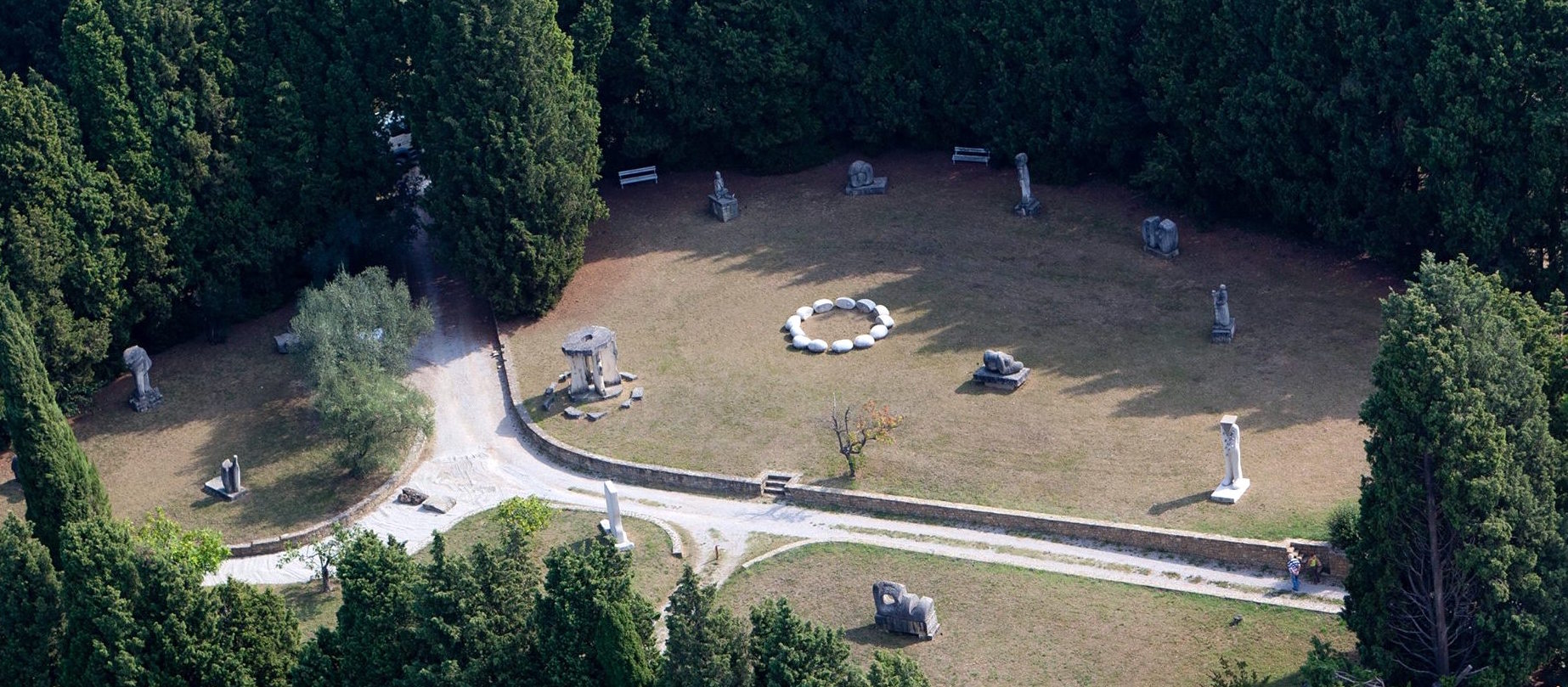
Istrian stone and olive grove
The International Sculpture Symposium Forma viva has connected sculptors from around the world, encouraging the creation of monumental stone sculptures in an open-air setting. The artists use stone from the quarries of the Istrian Peninsula, which significantly shapes the appearance of the sculptures, the identity of the entire collection, and the shared Venetian cultural space. High-quality Istrian limestone, once one of the main materi- als used in the construction of Venice, bridges the gap between the modern era and the ancient tradition of its use in building construction.
The stone sculpture park is a place where art is interwoven with the distinctive Istrian landscape and the rich natural heritage of the area. Part of this cultural landscape is the demonstration olive grove, featuring all seven indigenous »Piran« olive varieties: piranska buga, črnica, mata, komuna, smartel, štorta and žižola. Olive growing has a long tradition in Istria, and Istrian olive oil was already highly valued in antiquity, as confirmed by the writ- ings of Pliny, Martial, Galen, and Apicius, as Carlo Hugues wrote in 1902.
Past Editions: links
Chronology of the Symposia
1961
Ana Bešlić, nekdanja Jugoslavija (ex YU) · Pat Diska, ZDA (USA) · Eugène Dodeigne, Francija (F) · Yasuo Mizui, Japonska (J) · Josef Pillhofer, Austria (A) · Carlo Ramous, Italija (I) · Ivan Sabolić, nekdanja Jugoslavija (ex YU) · Giancarlo Sangregorio, Italija (I) · Hajime Togashi, Japonska (J) · Olgierd Truszynski, Poljska (PL) · Carl Kneulman, Nizozemska (NL)
1962
Tadesse Belaineh, Etiopija (ETH) · Teddy Carrasco, Bolivija (BOL) · Nino Cassani, Italija (I) · Otto Eder, Austria (A) · Jovan Kratohvil, nekdanja Jugoslavija (ex YU) · Janez Lenassi, nekdanja Jugoslavija (ex YU) · Ewelina Michalska, Poljska (PL) · Branko Ružić, nekdanja Jugoslavija (ex YU), Leo De Vries, Nizozemska (NL) · Methe Dharmani, Indija (IND) · Yoshio Hosoi, Japonska (J)
1963
Achiam – Ahiam Shoshany, Izrael (IL) · Aldo Calò, Italija (I) · Hubert Dalwood, Velika Britanija (UK) · Bernard Davis, Velika Britanija (UK) · David Hayes, ZDA (USA) · Olga Jančić, nekdanja Jugoslavija (ex YU) · Henri Lenaerts, Belgija (B) · Nakai Nobuya, Japonska (J) · Alina Szapocznikow, Poljska (PL) · Drago Tršar, nekdanja Jugoslavija (ex YU)
1964
Stojan Batič, nekdanja Jugoslavija (ex YU) · Stefania Bragaglia Guidi, Italija (I) · Louis Chavignier, Francija (F) · Magda Frank, Argentina (RA) · Shigeto Shimano, Japonska (J) · John Skelton, Velika Britanija (UK)
1965
René Coutelle, Francija (F) · Janez Pirnat, nekdanja Jugoslavija (ex YU) · Jirô Sugawara, Japonska (J)
1967
Roger Barr, ZDA (USA) · Miša Sarić, nekdanja Jugoslavija (ex YU) · David Thompson, Velika Britanija (UK) · Tomita Shinpei, Japonska (J)
1969
Leonard Agrons, ZDA (USA) · Svetomir Arsić, nekdanja Jugoslavija (ex YU) · Luciano Ceschia, Italija (I) · Hiroshi Onari, Japonska (J)
1971
Ante Jakić, nekdanja Jugoslavija (ex YU) · Jozef Jankovič, nekdanja Češkoslovaška (ex CS) · Akio Sakai, Japonska (J) · Geoffrey Smedley, Velika Britanija (UK) · Hisao Suzuki, Japonska (J)
1973
Shelley Fausset , Velika Britanija (UK) · Jaroslav Kubička, nekdanja Češkoslovaška (ex CS) · Shigeru Sugimoto, Japonska (J)
1975
Milomir Jevtić, nekdanja Jugoslavija (ex YU) · Kazuo Kitajima, Japonska (J) · Kirk Newman, ZDA (USA) · Kazimierz Łukasz Żywuszko, Poljska (PL)
1977
Adam Henein, Egipt (ET) · Anamaria Kubach Wilmsen, nekdanja ZR Nemčija (ex D) · Wolfgang Kubach, nekdanja ZR Nemčija (ex D) · Colette Perazio ltkin, ZDA (USA) · Dragan Poposki – Dada, nekdanja Jugoslavija (ex YU)
1979
Atsuchi Masanobu, Japonska (J) · Mirsad Begić, nekdanja Jugoslavija (ex YU) · Francisco Gazitua, Čile (RCH) · Dieter Hastenteufel, Kanada (CDN) · Erik Lovko, nekdanja Jugoslavija (ex YU)
1981
Miloslav Chlupáč, nekdanja Češkoslovaška (ex CS) · Đorđije Crnčević, nekdanja Jugoslavija (ex YU) · Ivan Kožarić, nekdanja Jugoslavija (ex YU) · Bjørn Nørgaard, Danska (DK) · Yutaka Okano , Japonska (J) · Leonard Rachita, Romunija (RO)
1983
Robert Du Bourg, ZDA (USA) · Hiroshi Mikami, Japonska (J) · Jiři Bezlaj, nekdanja Jugoslavija (ex YU) · Ante Marinović, nekdanja Jugoslavija (ex YU) · Jãnis A. Karlovs, nekdanja Sovjetska zveza (former SU), Takeshi Tanabe, Japonska (J) · Antonius Mÿsberg, Nizozemska (NL)
1985
Adrian lonita, Romunija (RO) · Stephan Kamenyeczky, Austria (A) · Ljubomir Karina, nekdanja Jugoslavija (ex YU) · Janez Lenassi, nekdanja Jugoslavija (ex YU) · Masayuki Nagase, Japonska (J) · Adolf Ryszka, Poljska (PL)
1987
Mathias Hietz, Austria (A) · Harunori Fujimoto, Japonska (J) · Jun Ohara, Japonska (J) · Zoltán Pál, Madžarska (H), Peter Roller, nekdanja Češkoslovaška (ex CS) · Zmago Posega, nekdanja Jugoslavija (ex YU) · Bata Marianov, Romunija (RO) · Masayuki Nagase, Japonska (J) · Dimćo Pavlov, Bolgarija (BG)
1989
Giancarlo Fasoli, Italija (I) · Gheorghe lliescu-Călineşti, Romunija (RO) · Alois L. Lindenbauer, Austria (A) · Joko Sako, Japonska (J) · Mustafa Skopljak, nekdanja Jugoslavija (ex YU) · Arne-Bernd Rhaue, nekdanja ZR Nemčija (ex D)
1991
Villi Bossi, Italija (I) · Miloslav Chlupáč, nekdanja Češkoslovaška (ex CS) · Milena Lah, Hrvaška (HR) · Janez Lenassi, Slovenija (SLO) · Gail Clair Morris, Velika Britanija (UK)
1993
Hartwig Rainer Mülleitner, Austria (A) · Yoshin Ogata, Japonska (J) · Goran Štimac, Hrvaška (HR)
1995
Atanas Atanasoski, Severna Makedonija (NMK) · Janez Lenassi, Slovenija (SLO) · Ljubo De Karina, Hrvaška (HR) · Nobuaki Kanamori, Japonska (J) · Richard Perry, Velika Britanija (UK)
1997
Kiar Meško, Slovenija (SLO) · Gualtiero Mocenni, Italija (I) · Dragan Poposki – Dada, Severna Makedonija (NMK) · José Ramón Villa Soberón, Kuba (C) · Roberto Stell, Slovenija (SLO)
1999
Villi Bossi, Italija (I) · Erik Lovko, Slovenija (SLO) · Graziano Pompili, Italija (I)
2001
Matejka Belle, Slovenija (SLO) · Carlos Monge, Mehika (MEX) · Emir Krajišnik, Švedska (S) 2003 Juan Narciso Quintanilla Álvarez, Kuba (C) · Vladimir Makuc, Slovenija (SLO) · Georg Ahrens, Nemčija (D)
2005
Gail Clair Morris, Velika Britanija (UK) · Ljubo De Karina, Hrvaška (HR) · Metod Frlic, Slovenija (SLO)
2007
Janez Lenassi, Slovenija (SLO) · Jozef Jankovič, Slovaška (SK) · Karel-Heinz Deutsch, Nemčija (D) · Makoto Fujiwara, Japonska (J)
2009
Chris Peterson, Nizozemska (NL) · Gorazd Poposki, Severna Makedonija (NMK) · Peter Roller, Slovaška (SK) · Li Zhao, Kitajska (CHN)
2011
Graziano Pompili, Italija (I) · José Ramón Villa Soberón, Kuba (C) · Donald Porcaro, ZDA (USA)
2013
Skulptura v naravnem in urbanem prostoru / Scultura nel parco e nello spazio urbano / Sculpture in Natural and Urban Settings (Konferenca / Conferenza / Conferences)
2015
Renzo Durante, Italija (I) · Miha Pečar, Slovenija (SLO) · Marko Zelenko, Slovenija (SLO) 2017 Sašo Sazdovski, Severna Makedonija (NMK) · Boštjan Kavčič, Slovenija (SLO) · Sari Çağdaş, Turčija (TR)
2019
Behnam Akharbin Moghanlou, Iran (IR) · Laura Marcos, Argentina (RA) · Arijel Štrukelj, Slovenija (SLO)
2021
Max M. Seibald, Austria (A) · Alberto Scodro, Italija (I) · Jure Markota, Slovenija (SLO) · Mário Lopes, Portugalska (P)
2023
Ištvan Išt Huzjan, Slovenija (SLO) · Emma Jääskeläinen, Finska (FIN)
2025
Giorgio Andreotta Calò, Italija (I).