Nina Mršnik: The Apartment |
Solo exhibition |
Loža Gallery, Koper,
23. 10. 2026–20. 2. 2027 |
Opening: Friday, 23. 10. 2026, at 19.00.
After more than a decade working on the Kobeiagi Kilims and Pečeno pohištvo projects, designer Nina Mršnik is embarking on a new phase of her creative practice. The exhibition Apartment at the Loža Gallery in Koper is a space for questioning and reassembly, raising questions about what it means to be a woman designer over forty in Slovenia’s post-industrial environment, where to position oneself after completing long-term projects, and under what economic conditions it is even possible to sustain a creative practice today.
The starting point of the exhibition Apartment is personal, but it opens onto broader questions of dwelling, survival, and the conditions under which creative work can become/remain a way of life. Reflection on design is therefore inseparable from the material and economic circumstances that enable, or constrain, a creator’s ability to devote time, space and persistence to their work.
Nina, who comes from Koper and inherited an apartment in Slovenia’s capital from her Ljubljana grandmother, thus finds herself in a paradoxical position: it is material security, a privilege in its own right, that enables her to continue working in culture and design.
For the duration of the exhibition, the Loža Gallery is therefore transformed into an apartment, both a real and symbolic space for a creative life. Visitors enter not a conventional gallery installation, but an environment reminiscent of a home, composed of an entrance hall, kitchen, living area, and transitional spaces where finished products, prototypes, and old ideas that have finally been realized, matured and taken shape over time are interwoven.
The apartment thus becomes a model of the creative process. The objects are presented not as isolated finished products, but as part of the story of how they came into being. Furniture, ceramics and textile elements bring together the different materials and approaches with which the designer works. Their practical use is intertwined with conceptual value, while individual objects reveal the processes from which they emerged: experimentation, prototyping, and gradual transformations of ideas.
This is also where the exhibition Apartment reveals its wider significance. Nina stands at a transition between completed long-term projects and something that is only beginning to take shape. From the outset, her work has been marked by a desire for design to transcend the strict boundaries between art, design and everyday life. She reflects on materiality, sustainability and ways of giving something old and discarded new (symbolic and emotional) value.
In this, the designer draws on the design legacy of outstanding figures such as Ettore Sottsass and Michele De Lucchi, whose work has profoundly shaped her understanding of objects, space, colour and function. Their approaches are a source of inspiration, but Nina translates them into her own material and personal language.
Ana Papež, curator and educator, PCG
MRŠNIK APARTMENT
Between a Manifesto and Useful Memories
I am the daughter of architects, and ever since I started drawing, I have drawn apartment floor plans. For this exhibition, I placed all my ideas inside an apartment.
- I no longer want to fit the mould of a designer/illustrator.
“There won't be any work left for us unless we create it.” This was the motto of my study group at the Royal College of Art in London.
- I want to start new, long-term projects.
- I need to draw more.
“Just keep drawing,” my favourite professor, Jurgen Bey, told me twenty years ago. At the time, I had only just begun studying product design, and I did not understand what or how I was supposed to draw as a product designer.
For the exhibition, I created a project called Furniture with Tattoos. To convey the idea, I used a family wardrobe that belonged to my grandmother’s parents. I drew parts of my family history on it: my grandparents, my mother, and tracings of my children’s drawings… I want these additions to root the wardrobe more firmly in our family and for it to keep passing from one generation to the next. I want all furniture to be made well enough to be passed down. I also want the tattoos to add value, turning the tattooed pieces into something that can no longer simply be thrown away.
- I need to learn new skills.
- I want to collaborate with people who excel at what they do.
I began collaborating with the potter Urban Magušar, who is my uncle. He gave me access to his workshop and complete freedom to do whatever I wanted. The other day, he bent a grater into a circular shape so that I could sand the clay. He says he really likes what I am doing. For now, this means bowls, lamps and ceramic faces.
My second collaboration is with Ana Malalan of Anselma, who helped me with all her expertise. Anselma also produced all the textile elements for me (except the faces) from old material.
- Most materials in the exhibition should have been used before.
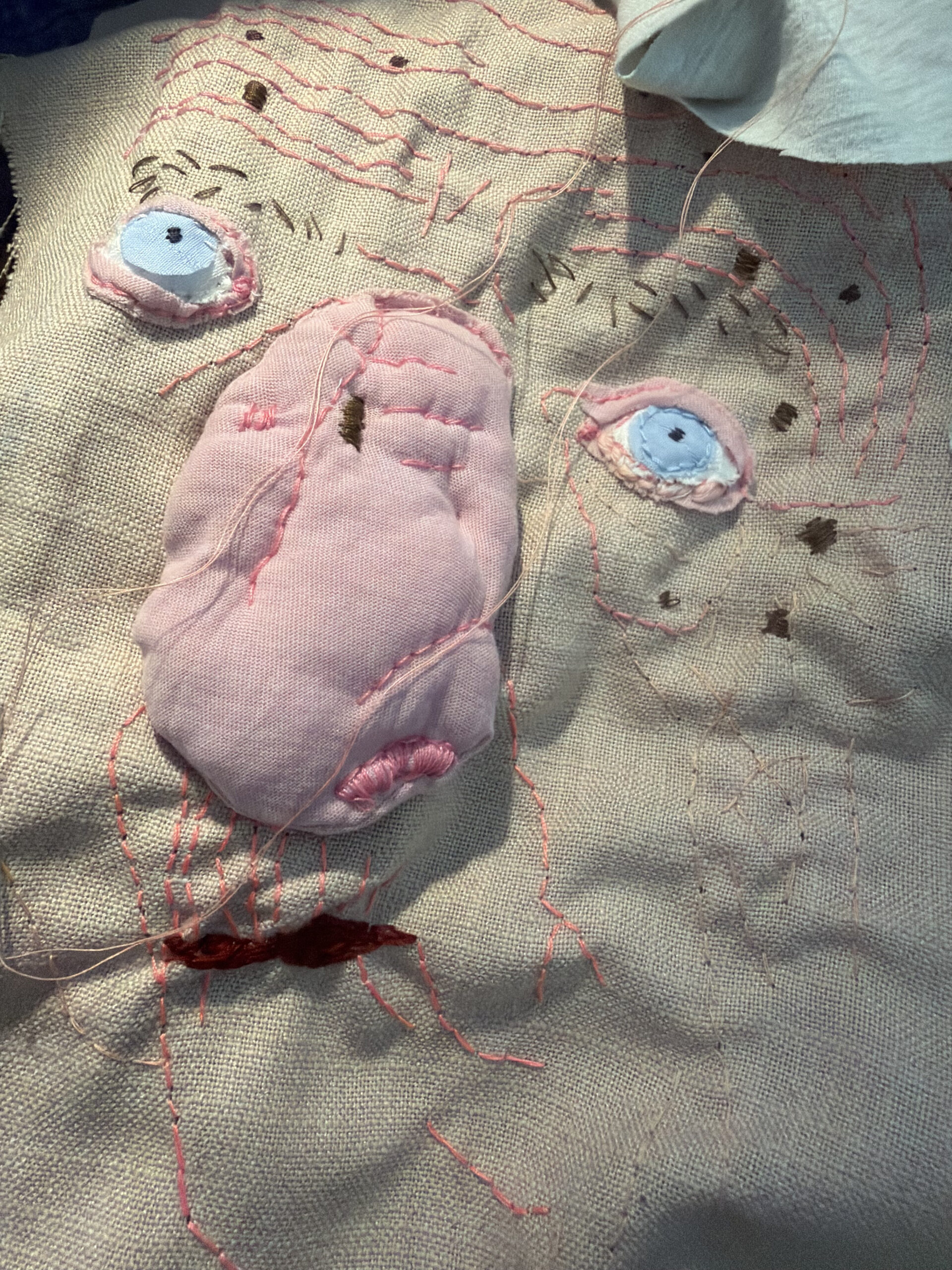
Every year I throw away a mountain of children’s clothes that are permanently stained and torn. What can this fabric offer me? I have always enjoyed the leap from 2D to 3D.
So I added textile portraits to the portraits on paper and wood.
The textile faces in the exhibition are the residents of my apartment, or my friends who came over for dinner.
- Ideally, I devise the process myself.
- I will make most of the pieces in the exhibition myself.
“Ceramics is something you do twenty-four hours a day,” Urban told me when I left his workshop in Radovljica very early to pick up the children from nursery and school on time. My time is not uninterrupted; it is split between motherhood and creative work.
Yet having to do a hundred things at once every day has enabled me to create my own process, one that works within my constraints.
Creating this exhibition while letting go of some old projects I had worked on for more than a decade gave me insight into my own creative practice. I tried to observe myself from a distance and consciously sought old and new references for what I do. For me, the exhibition is a look inward: at what I do and how I do it. It reflects on this process and its place in the past and the future.
- Everything in the exhibition is for sale!
I need to build up capital for the next exhibition.
As I write this text, things are still coming together. I write about the projects as fragments, because I want visitors to discover them for themselves, slowly.
I do know what feeling I want to leave visitors with. Welcome to my home.