FRANCESCO BERTOCCO. BREAKING THE CIRCUIT OF CONTROL |
Exhibition Opening and Launch of the Catalogue |
Fotografija Gallery, Centre Rog, Trubarjeva cesta 72, Ljubljana |
Opening: Saturday, 12. 9. 2026 at 18.00 |
12. 9.— 3. 10. 2026 |
Curated by: Gabi Scardi, with Mariagrazia Muscatello.
The project publication, commissioned by Piran Coastal Galleries and edited by Gabi Scardi, will be published and distributed by Humboldt Books Milano. It brings together essays and critical contributions by different authors.
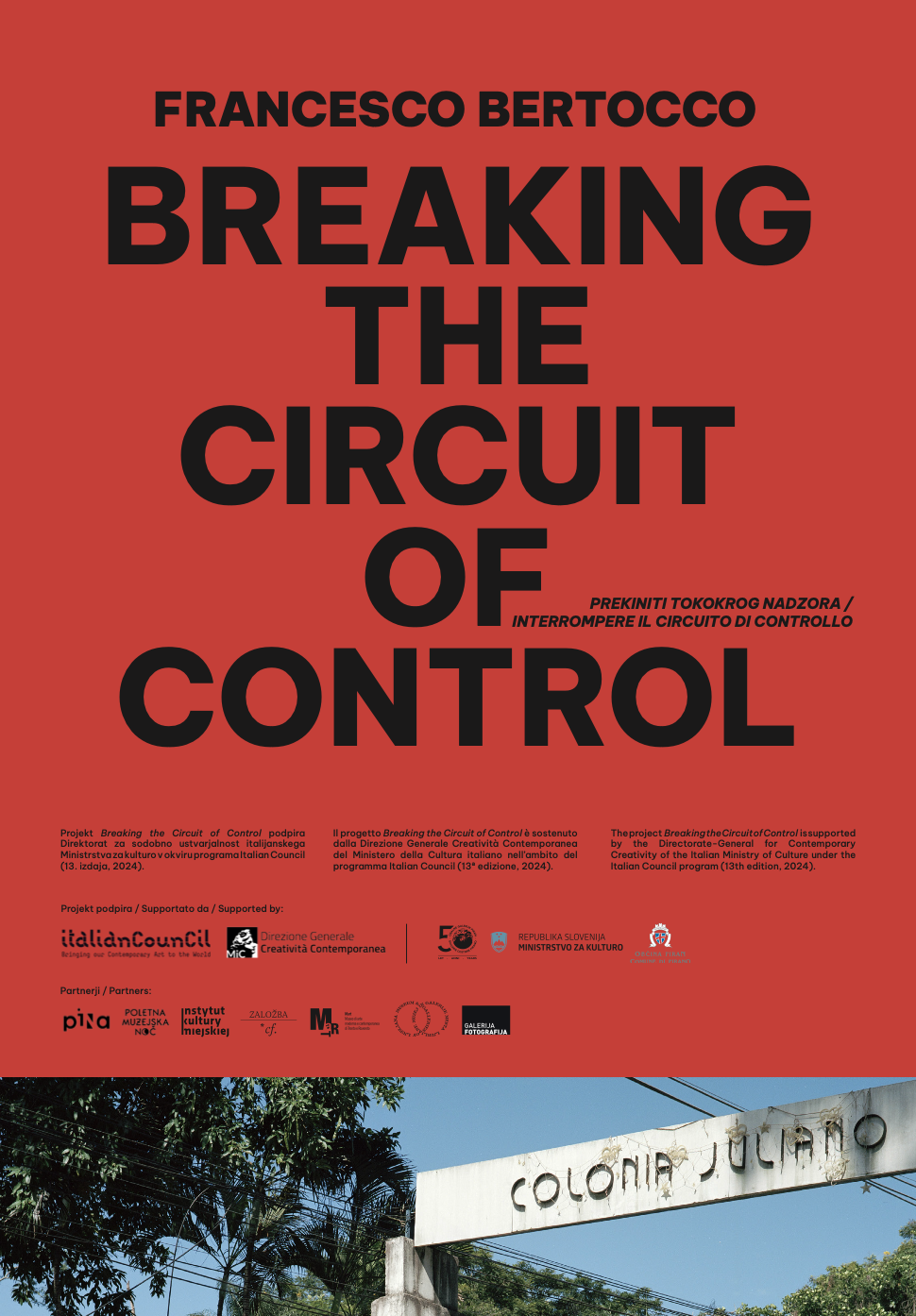
On Saturday, 12 September 2026 at 10.00, the City Museum of Ljubljana will host a discussion and screening of the film O homem no pelourinho by Francesco Bertocco.
Participants: Francesco Bertocco and prof. Vito Flaker, PhD.
More about the project → FRANCESCO BERTOCCO. BREAKING THE CIRCUIT OF CONTROL – Obalne Galerije Piran
International Public Programme: https://www.obalne-galerije.si/en/francesco-bertocco-breaking-the-circuit-of-control-travelling-international-public-programme-2026/
The project Breaking the Circuit of Control is supported by the Directorate-General for Contemporary Creativity of the Italian Ministry of Culture under the Italian Council program (13th edition, 2024), which aims to promote Italian contemporary art worldwide.
Breaking the Circuit of Control is a project by artist Francesco Bertocco.
Having long been interested in the history of medicine and therapeutic practices, Bertocco focuses here on the figure, thought, methods, and lasting influence of Franco Basaglia, the prominent intellectual and reformer of modern psychiatry.
Active in Italy from the 1960s until his passing in 1980, Basaglia’s relentless efforts catalyzed the birth of the anti-asylum movement. His work sparked a radical revision of the concept of the “danger" of psychiatric illness, as well as treatments based on methods of physical restraint.
In 1978–1979, the international resonance of his activism brought him to Brazil.
Breaking the Circuit of Control centers precisely on this experience.
During his travels in Brazil, the psychiatrist met with leading figures of Brazilian psychiatry, held a series of conferences and debates at various research institutions, and visited facilities such as Juquery – one of the largest psychiatric institutes of the twentieth century – the University Hospital of Belo Horizonte, and the Colônia Hospital in Barbacena, where patients lived in tragic conditions.
The impact of his presence on the Brazilian psychiatric landscape was profound and enduring. The ultimate outcome of these journeys was the 1979 publication of the Conferenze Brasiliane (Brazilian Lectures), in which Basaglia expressed the critical passion and urgency of his reflections.
Francesco Bertocco’s project is the result of extensive investigation and field research.
The artist retraced the steps of Basaglia's journey and met with individuals who were close to him during his time in Brazil.
The resulting body of work consists of a series of photographs taken at Juquery and other sites visited by Basaglia, alongside a video in which his choices, methods, and the atmosphere of the Brazilian debates are evoked through a participatory staging.
While the primary intent is to highlight the value of the work carried out by the intellectual and neuropsychiatrist in fostering a new awareness and imagination regarding mental distress, several other themes intersect within this research. These range from the history of how mental illness and its treatment are perceived, to the significance of architecture and its conditioning role on the individual, the idea of infrastructure, and the concept of the “total institution"- a structure that contributes to the establishment of a specific system based on control.
Broadening its scope even further, the project articulates the highly contemporary issue of exclusion and confinement: treatments reserved for those who, for various reasons, deviate from the norm and are consequently deemed “other," alien, or dangerous.
Gabi Scardi